
Red Light Wavelengths Explained

The benefits of red light therapy for health and skin come from the use of specific wavelengths of red and near infrared light. These wavelengths interact with biological processes inside the body and have been studied extensively in the field of photobiomodulation.
In this article, we explain what wavelengths are, how they fit within the visible light spectrum, and which wavelengths are most commonly used in red light therapy treatments.
What is the Wavelength of Red Light?
The wavelength of red light falls between approximately 620 and 750 nanometers (nm) on the electromagnetic spectrum. The electromagnetic spectrum represents the full range of light energy that reaches Earth from the sun, including both visible and invisible wavelengths. [1,2,3]
Within this range, red light sits at the longer wavelength end of the visible spectrum. As wavelengths increase beyond visible red light, they move into the near infrared portion of the spectrum, which is invisible to the human eye but still interacts with biological tissue.
Both red and near infrared wavelengths are used in photobiomodulation research and light therapy treatments.
Red Light Wavelengths, Colors, and the Visible Spectrum
Light is energy from the sun in the form of different wavelengths and colors. The sun shines full-spectrum light that includes all the colors and waves on the electromagnetic spectrum.
The visible spectrum of light includes the following colors and wavelengths:
Violet light (380-450 nm)
Blue light (450-495 nm)
Green light (495-570 nm)
Yellow light (570-590 nm)
Orange light (590-620 nm)
Red light (620-750 nm)
[1,2,3]
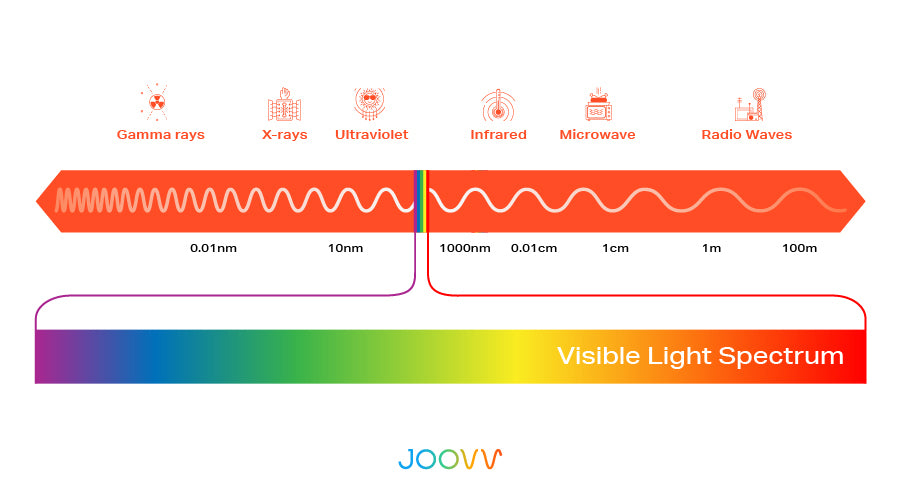
Check out this post to learn more about the basics of light, wavelengths, colors, energy, and how different colors affect human biology.
What are the Best Wavelength for Red Light Therapy?
While red light spans a wide range of wavelengths, most human photobiomodulation research focuses on narrower wavelength ranges within the red and near infrared portions of the spectrum.
Two ranges appear most frequently in clinical research:
Red light between approximately 630 and 660 nm
Near infrared light between approximately 800 and 850 nm
These wavelengths interact with enzymes involved in cellular energy production inside the mitochondria. Because of this interaction, they have been widely studied for applications related to skin health, recovery, inflammation, and circulation. [4,5,6,7]
When evaluating light therapy systems, the goal is not simply to use any red wavelength, but to use wavelengths that have been studied in human research and shown to produce biological responses.
What is the Difference Between Red Light and Near Infrared Light (NIR)
Red light and near-infrared light behave slightly differently when interacting with the body.
Red light is visible to the human eye and tends to interact with tissue closer to the surface of the skin. Because of this, red wavelengths are commonly associated with skin related applications.
Near infrared light is invisible to the human eye and penetrates deeper into biological tissue. Near infrared wavelengths are often used in research related to muscles, joints, and recovery.
Many photobiomodulation systems combine both red and near infrared wavelengths to support treatment across different tissue depths.
Why Wavelength Selection Matters
One trend that has emerged in the light therapy industry is the use of many different wavelengths in a single device. Some products advertise four, five, or even seven wavelengths.
However, most peer reviewed human research focuses on relatively narrow wavelength bands rather than large arrays of adjacent wavelengths.
Wavelengths that are very close to each other within the same spectral range interact with many of the same biological targets. Because of this, expanding the number of wavelengths does not necessarily improve results unless those wavelengths have been specifically studied in clinical settings.
Researchers typically focus on delivering well studied wavelength ranges with consistent dosing and treatment duration rather than maximizing the number of wavelengths.
Red Light Wavelengths in Joovv Devices
Advances in LED technology make it possible to isolate specific wavelengths of red and near infrared light for therapeutic use.
Joovv devices use red wavelengths at 660 nm and near infrared wavelengths at 850 nm. These ranges have been widely studied in photobiomodulation research and are commonly used in clinical experiments.
By focusing on these well researched wavelength bands, light therapy systems can deliver consistent energy to the body without spreading output across many adjacent wavelengths.
When using a Joovv device, users can select visible red light, near infrared light, or a combination of both depending on their treatment preference.
Red Light Wavelengths and Blue Light Wavelengths
Blue light wavelengths are in the 450 to 495 nanometer range, and have a higher frequency (or shorter wavelengths) than red light. Blue light is also much brighter than red light, which is why it can cause sleep and headache problems when you take in too much blue light at night from screens and artificial lighting. [8,9]
Red light therapy is a great way to counter that blue light, especially with features like Joovv’s Ambient Mode. Ambient Mode delivers less intense light that’s ideal for nighttime. You can read more about blue light and the negative effects of bright blue light here.
Conclusion: Red Light Therapy Wavelengths and Biological Effects
Red light therapy works because certain wavelengths of red and near infrared light interact with biological processes inside the body. These interactions can influence cellular energy production and signaling pathways involved in recovery, skin health, and overall cellular function.
While red light spans wavelengths from approximately 620 to 750 nm, most photobiomodulation research focuses on narrower wavelength ranges within the red and near infrared spectrum.
Using wavelengths that have been studied in human research helps ensure that light therapy treatments deliver the type of light energy the body can actually use.
When the appropriate wavelengths are delivered at the correct dose, red light therapy can support a range of biological processes that contribute to overall health and recovery.


Sources and References:
[1] Elert, Glenn. "The Electromagnetic Spectrum, The Physics Hypertextbook." Hypertextbook.com.
[2] Kumar, Narinder. 2008. Comprehensive Physics XII. Laxmi Publications.
[3] Laufer, Gabriel. 1996. Introduction to Optics and Lasers in Engineering.
[4] Cleber Ferraresi, Michael R Hamblin, Nivaldo A Parizotto. Low-level laser (light) therapy (LLLT) on muscle tissue: performance, fatigue and repair benefited by the power of light. Photonics Lasers Med. 2012 Nov 1;1(4):267-286
[5] Cleber Ferraresi, Ying-Ying Huang, Michael R Hamblin. Photobiomodulation in human muscle tissue: an advantage in sports performance? J Biophotonics. 2016 Dec;9(11-12):1273-1299
[6] Avci P, Gupta A, Sadasivam M, Vecchio D, Pam Z, Pam N, Hamblin MR. Low-level laser (light) therapy (LLLT) in skin: stimulating, healing, restoring. Semin Cutan Med Surg. 2013 Mar.
[7] Hamblin M. “Mechanisms and applications of the anti-inflammatory effects of photobiomodulation.” AIMS Biophys. 2017.
[8] Jung C, Khalsa S, et al. Acute Effects of Bright Light Exposure on Cortisol Levels. Journal of Biological Rhythms. 2010 Jun.
[9] Harvard Health. Blue light has a dark side.
JV-MKT-DOC-4785 VER.1